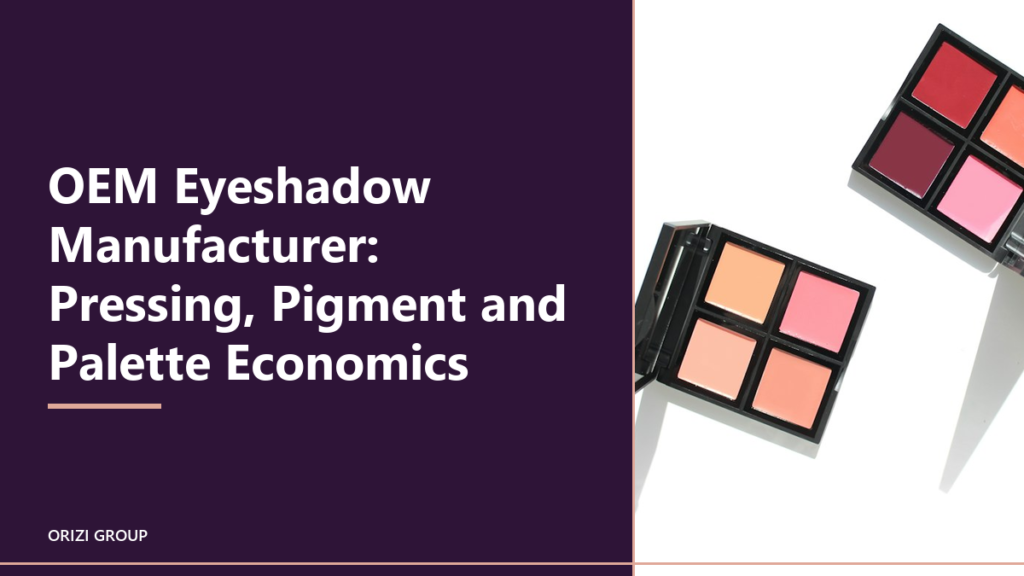
A palette is priced by the pan, but it is judged by the swatch. Between those two facts sits the pressing trial, where most of the money and nearly all of the delay live. This is how an OEM Eyeshadow Manufacturer actually builds a quotation.
What an OEM Eyeshadow Manufacturer Prices Differently
Pigment load, binder system, pan size and the number of shades are priced separately, not as one palette rate.
Pigment load is quoted as a percentage but experienced as payoff and fall-out. A palette that swatches strongly and crumbles in the pan carries too much pigment for its binder, and the repair is a formula change rather than a pressing adjustment.
High pigment load raises cost and shortens wear time on the skin if the binder cannot carry it. Sparkle finishes add a coating step. A quotation that gives one blended price for a nine-pan palette is hiding which of those four is driving it.
Pressing trials are quoted separately for a reason. A shade that works on a small press can fail on a production press at a different pressure, and the trial is what closes that gap before the palette is committed.
Which Binder System Suits Your Palette
Talc-based systems press easily and cost less; mica and silica systems give a cleaner payoff but demand tighter process control.
The binder decides whether a shade presses at all. Talc-based systems are forgiving, while mica and silica systems need tighter control of pressure and moisture, which is why a sensible factory quotes a trial before quoting a palette.
Choose the system by the claim, not by the trend. A pressed pigment with no talc needs a different press pressure, and that is a trial, not a line item you can assume.
How an OEM Eyeshadow Manufacturer Tests Pressing Before a Full Run
Press a small batch, drop-test the pan, and check for fall-out on the brush before approving the bulk.
Drop testing is the step brands skip and then regret. A pan that survives a press can still crack in a courier van, and the test costs an afternoon while the returns cost a season of reviews.
Fall-out is the failure that reaches the customer, and it shows up in the first press, not the ninth. Ask to see the drop-test result alongside the swatch, because a palette that swatches beautifully and crumbles in transit is a return waiting to happen.
Ask which shades in the range share a base. Three shades built on one base press faster and cost less than three separate formulations, and the difference shows up in the second order rather than the first.
Where an OEM Eyeshadow Manufacturer Loses Money on Palettes
In pans that are too deep, magnets that add a step, and shade names that change after the artwork is approved. A palette priced by an OEM Eyeshadow Manufacturer per pan rarely includes the drop test, and the drop test is the cost.
Deep pans look generous and cost more in three places: the insert, the press time and the freight weight. A standard pan with a good formula usually outperforms a deep pan with an average one.
Deep pans hold more product and look generous, and they also need a stronger press and a heavier insert. Those costs are invisible on a shelf but very visible on a repeat order.
Check the insert as carefully as the shade. A palette that rattles on arrival reads as poor quality even when the formula is good, and the fix is a moulded insert rather than a better pigment.
Who Owns the Shade Names?
The brand owns the names and the shade architecture; the factory owns the formula codes behind them.
Write the mapping down. When a name changes, the formula code should not, and a documented mapping lets you reorder the exact shade six months later without resubmitting a standard sample.
Shade names belong to the brand, formula codes belong to the factory, and the mapping between them belongs in writing. Without it, a reorder six months later becomes a colour-matching exercise with no reference point on either side.
An OEM Cosmetic range built on shared pigment bases can add a palette without new development, because ORIZI Group already runs those bases across its colour lines. That is the cheapest route from one product to a shelf presence. Pressed formats and binder options are on orizigroup.com. An OEM beauty product manufacturer Malaysia comparison should put the same four lines side by side.